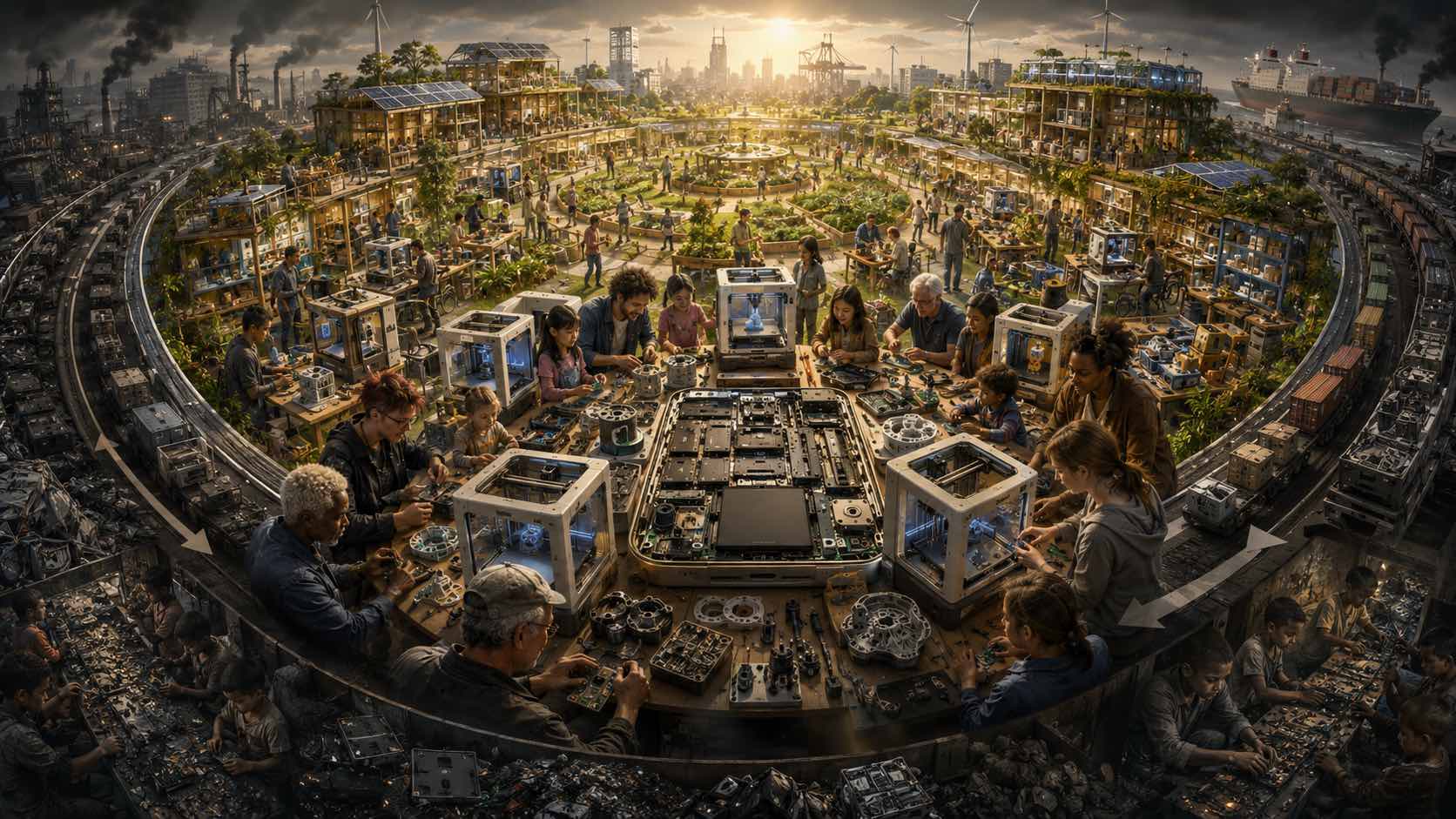
The End of the Waste-Based Civilization
If future historians look back at the turn of the 20th and 21st centuries, it is not the wars or political ideologies that will astound them the most. The most unfathomable aspect will be the institutionalized madness through which a technologically advanced civilization consciously and systematically transformed its own planet’s finite resources into waste—simply to ensure the numbers in a fictitious financial system could perpetually increase.
This is the era of “planned obsolescence.” It is the system’s greatest physical crime, where human genius and engineering expertise were not used to create durable, lasting value, but to artificially shorten the lifespan of products and degrade the planet into a gigantic landfill.
Engineered Death: The Original Sin of the Phoebus Cartel
The historical origin of this destructive logic dates back to the 1920s with the formation of the Phoebus cartel. The world’s largest lightbulb manufacturers met in secret and realized they had a “fatal” problem: their technology was too good. Lightbulbs lasted for 2,500 hours, which drastically reduced repeat sales.
The cartel therefore made the most cynical decision in modern economic history: with engineering precision, they deliberately degraded the quality of their bulbs, capping their lifespan at 1,000 hours. Anyone who dared to release a more durable product onto the market was ruthlessly punished by the cartel. Death was engineered into the products. The task of engineers was no longer perfection, but the predictable, precise timing of failure.
The Biological Invasion and the Microplastics Absurdity
This cartel logic became the entire industrial backbone of the past century. To keep the machine spinning, industry shifted to the infinite production of cheap, non-biodegradable, disposable materials—primarily plastics. The economy turned the artificial acceleration of entropy (physical degradation) into a business model.
However, the physical destruction wrought by the system did not stop at the borders of landfills and oceans; it penetrated the deepest, most sacred layers of our biological existence. The byproducts of infinite waste production—microplastics—have now become an integral part of the food chain and the human body.
And this is where the system reveals its most demonic, absurd face. When independent researchers detected microplastics in the human bloodstream, in brain tissue, and even in the placenta nourishing unborn fetuses, the machine did not stop. Decision-makers did not sound the alarm, nor did they immediately shut down the chemical plants poisoning the planet.
Instead, the previously exposed media matrix kicked into gear to do its job: normalizing the horror. The mainstream press began publishing cynical, lifestyle-magazine-style articles about how to “coexist” with microplastics. As if the fact that industrial plastic waste is circulating in the veins of our children for the sake of profit maximization were not a civilizational crime, but a perfectly natural, acceptable, and even inevitable byproduct of modern life—like rainfall or the changing of the seasons. They are attempting to shove a cosmic biological disaster down our throats as everyday normality.
The Zero Tolerance of the Tabula Rasa: Open Source and Modularity
The “Great Giving Back” movement and the Tabula Rasa declare zero tolerance against planned obsolescence and the conscious poisoning of the biosphere. At the zero point, we state: the destruction of finite resources and the contamination of biological life’s informational code (DNA and tissues) for profit is the gravest of crimes. We are eradicating this practice with immediate effect.
The industrial standard of the new, energy- and information-based society is no longer replaceability, but maximum durability, modularity, and open-source.
- Every device must be designed so that its components are standardized, easily replaceable, and upgradeable.
- Engineering expertise returns to its original, noble mission: designing systems for immortality, not for failure and trash.
The Logic of Networked Reality: Waste as a System Error
This new paradigm is not enforced by bureaucratic authorities. The transition here, too, relies on the organic immune response of 21st-century networked lifeforms.
In a transparent, information- and energy-based network, planned obsolescence and biological poisoning can no longer be hidden behind PR articles. The network’s intelligence simply identifies microplastics and engineered flaws as informational entropy and a lethal virus, and immediately rejects them. In the new economy, a product that consciously wastes energy or damages the biological network does not generate profit; it suffers immediate reputational collapse and isolation.
As society transitions from the compulsion of ownership to the networked sharing of functionality and access, manufacturers will suddenly find that their only interest is ensuring their products never break down and never pollute. The era of planned obsolescence and normalized poisoning is over; we have reclaimed control over our own physical and biological reality.
Comments are closed