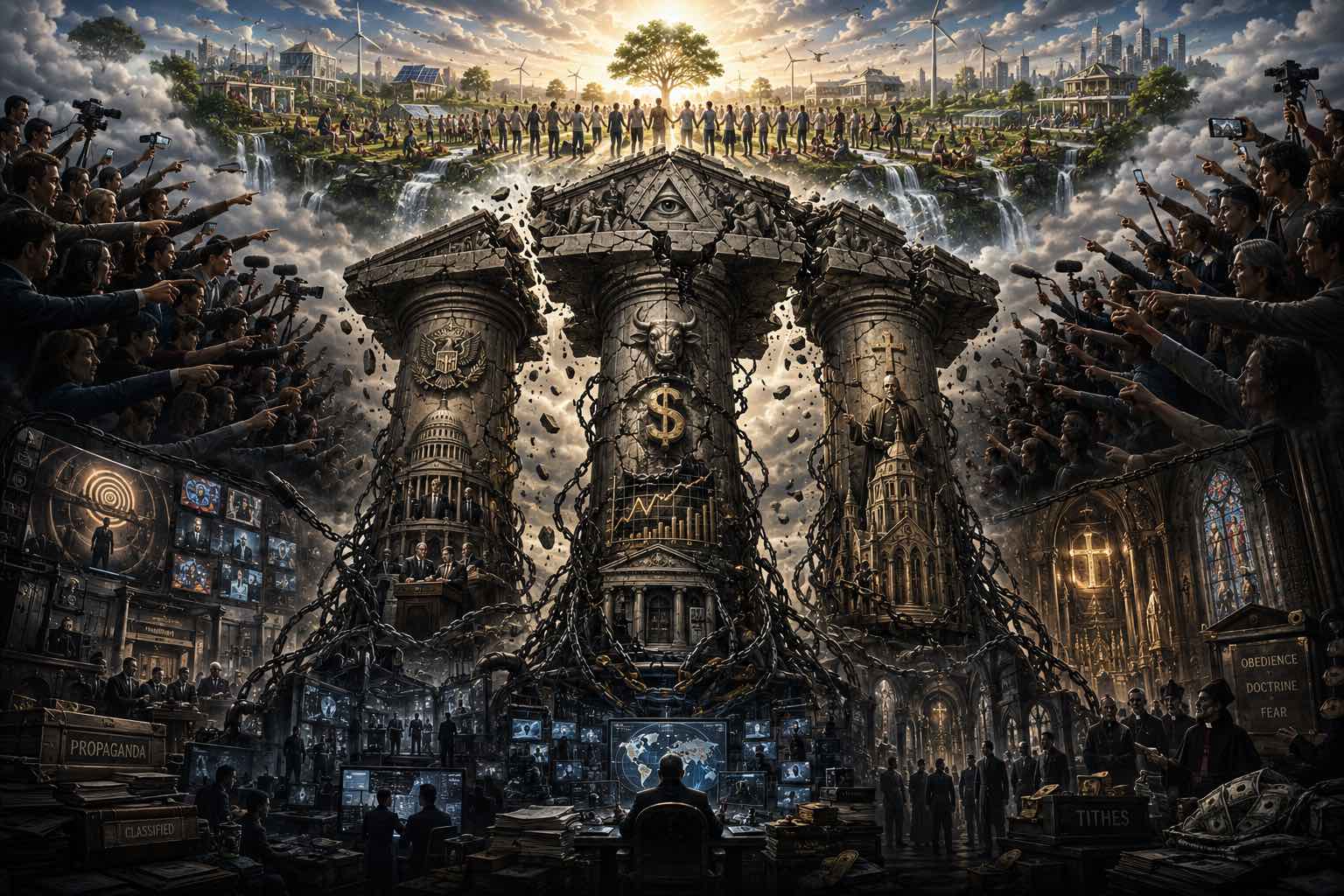
The Bankruptcy of Church, Politics, and the Economy
For centuries, the development of human civilization was determined by a peculiar, vertical power structure—the institutionalized holy trinity of politics, economics, and religion. Historically, these systems once served to organize society, distribute resources, and establish common moral frameworks. By the 21st century, however, this hierarchical model has reached its evolutionary limits and has become permanently obsolete.
Today, they no longer serve the common good but are focused exclusively on maintaining their own positions of power. Below, we explore how these three pillars have become the greatest obstacles to social progress and why their complete structural replacement is inevitable.
The Illusion of Politics: The Crippling of the Collective Psyche
The modern political elite—regardless of the ideological mask it wears—has lost touch with the real needs of society. Public administration and legislation have degraded into a bureaucratic machine that makes decisions based on the principle of the “weakest link” and the “lawnmower approach” (uniform leveling). In practice, this means the system does not support excellence and innovation; instead, it adjusts the social standard to mediocrity, stifling genuine understanding and creativity. Not to mention lobbying, which has “crept into” public political life over the past decades as an accepted channel of influence, even though the very idea that one can sway the decisions of elected representatives contradicts fundamental democratic values. This creates a kind of cognitive dissonance among the population.
This phenomenon was already described by the classics of sociology: Max Weber called bureaucracy an “iron cage”—a system that, in the name of rationality, gradually strips the individual of the opportunity for free choice. The totalitarian regimes of the 20th century (the information censorship of the Soviet planned economy or the state-party press control of the Eastern Bloc) are extreme but well-known examples of where it leads when power becomes the sole gatekeeper of information flow. In today’s democracies, this takes a subtler form: the 2013 Snowden affair highlighted the extent to which state organs can collect and control data without public knowledge—which aptly illustrates that the monopoly on information is not unique to dictatorships. Furthermore, it is an interesting observation of power dynamics that the restrictive rules applied to various crisis situations are often not revoked once the crisis has passed.
Power has realized that the most effective tool of control is the monopoly of information and the artificial division of society. By withholding and distorting information, politics has caused immeasurable damage to the collective psyche. It has created traumatized generations burdened with delusions who—lacking critical self-reflection—pass these false data and fears on to one another. Today, politics is no longer about representing the community, but about managing institutionalized manipulation and division.
The Destruction of the Economy: The Structure of the False Personality
The global economic system is perhaps the most destructive element of this trinity. The profit-oriented corporate sphere and the financial elite operate hiding behind a “false personality,” completely devoid of moral and ecological responsibility. They have made the world believe that infinite economic growth is possible on a planet with finite resources.
Initially, qualitative demands were the main considerations in the formation of the capitalist structure. Early mass production could not afford shoddiness, nor was it the goal. Companies took pride in their products and took customer satisfaction seriously. Then something happened at the dawn of the last century, and the owners saw blood; economic morality changed, and substantial profit was no longer enough. The new goal became profit maximization at all costs.
Planned obsolescence is not a theoretical concept: the Phoebus cartel, established in 1924—in which the leading lightbulb manufacturers of the time (including General Electric and Philips) agreed to intentionally limit the lifespan of their bulbs to one thousand hours—is one of the earliest documented proofs that artificial scarcity was inherently built into the structure of consumer society. This same logic lives on in today’s electronics industry, which economists, such as Kate Raworth in her work “Doughnut Economics,” identify as the fundamental contradiction of a model built on endless growth: infinite material growth on a finite planet is mathematically unsustainable.
The system has ruthlessly exploited the Earth’s raw materials while artificially generating scarcity and forced consumption through planned obsolescence. Power likes to call this mass psychological and economic manipulation “free-market capitalism” or “democracy.” In reality, it is neither. It is a self-sustaining, speculative mechanism built on the vulnerability of broad layers of society, while the profits are skimmed off by a narrow elite of owners. When an economy places profit above the quality of human life and the survival of the planet, it is no longer an economy—it is destruction.
The Discrediting of Churches: The Dogmatic Dead End
The third pillar of the holy trinity of power, institutionalized religion, has become a tool for mental control rather than supporting the spiritual development of the individual. Over the centuries, churches have hardened into dogmas, and their own personnel, burdened with human frailties, have rendered them unfit to fulfill their original, transcendent mission.
One of the most well-known, symbolic cases of hypocrisy is the affair of Galileo Galilei: the Catholic Church condemned the astronomer on charges of heresy in 1633, and only officially admitted its error in 1992, during the papacy of Pope John Paul II—nearly 360 years later. Similarly well-documented is the medieval trade in indulgences, against which Martin Luther’s actions in 1517 ultimately led to the Reformation: this historical moment in itself proves that turning spirituality into money and power is not a new problem, but a recurring pattern of the system. In the 21st century, the abuse scandals uncovered worldwide within the Catholic Church—and the subsequent, reluctantly delayed apologies dragging on for decades—show the modern continuation of this exact same pattern.
The hypocrisy in the system culminates in the fact that while it constantly tries to maintain the illusion of divine infallibility and absolute moral authority, on a historical scale it is repeatedly forced to apologize retroactively for its own mistakes, sins, and atrocities committed against humanity. Churches have attempted to monopolize faith, institutionalizing spirituality, which has effectively cut people off from genuine, internal understanding. Transcendent experience and freedom of religion are the inalienable, sacred rights of every human being—but exercising them no longer requires mediating institutions that trade spirituality for power and wealth.
Anyone can pose the question to artificial intelligence using the following prompt:
Examine as an alternative historical scenario what would have happened if, around 1900, the Roman Catholic Church had consciously broken with secular power alliances, renounced the primacy of wealth and authority protection, and acted consistently according to the teachings of Jesus throughout the entire 20th century. Analyze how it might have altered history if the Church had stood on the side of the poor, the oppressed, peace, equitable wealth distribution, human dignity, social responsibility, and non-violence in every situation.
Change as a Natural Process
In nature, every system—whether a cell, an ecosystem, or a society—seeks a new equilibrium from time to time when the old modes of operation no longer serve its development adequately. This is not a flaw or a collapse, but a natural rhythm: systems grow, adapt, and then take on a new form when necessary.
The same is true for human communities. The political, economic, and religious institutions that have served society for centuries have now reached a similar point of transformation. This does not necessarily mean they were inherently bad or have failed—rather, it means that the world they serve has changed around them, and now they too must change to continue creating value.
Just as a tree does not live with the same leaves for its entire life, social systems cannot remain in the same form forever. The question is not whether there will be change, but how we can shape this process consciously, cooperatively, and for the benefit of all.
The Path to Change: Horizontal Thinking and Network Culture
How do we move from obsolete vertical power structures to a viable future? The answer lies not in the desperate patching of old systems, but in a fundamental, qualitative shift in our thinking. This shift points away from hierarchical (vertical) subordination and toward coordinate, collaborative (horizontal) structures. As the article The Horizontal Vertical Thinking highlights, instead of linear, command-driven logic, we need a much more open, decentralized mindset built on collective intelligence. This horizontal approach allows individuals to connect directly with one another, without central intermediaries and artificial control.
This transformation is not an abstract, artificially invented utopia, but nature’s purely mathematical answer to increasing complexity. According to the rules of complexity, when a system—whether biological, ecological, or social—reaches a critical level of intricacy, centralized control becomes unsustainable. The solution is network culture: the emergence of open-source, self-organizing community systems. The essay The Network Society details how these network architectures provide vastly greater flexibility, resilience, and innovation potential. The “social operating system” of the future is built from decentralized communities, shared resources, and open knowledge bases—following the exact same fractal and networking principles that have made nature’s survival and evolutionary strategies successful for millions of years.
The Paradox of Internal Qualitative Leap
It is an interesting paradox that while macro-level social structures shift from vertical power to horizontal networks, this transformation occurs in the exact opposite direction within the individual’s internal development. As suggested in The Horizontal Vertical Thinking, liberation on a personal level means the individual finally frees themselves from attention-consuming, superficial “horizontal problems”—the mere material struggles and artificially generated conflicts. As these unnecessary burdens fade away, the concept and demand for quality expectation levels emerge within them. This is an internal, vertical elevation toward higher consciousness, genuine values, and deeper understanding.
Thus, a beautiful dual dynamics unfolds: while a healthy equalization takes place in the external world and macro-systems, making socio-economic cooperation entirely horizontal and egalitarian, the individual undergoes a qualitative dimensional leap internally. This personal, vertical elevation guarantees that the new, decentralized network society will not sink into mediocrity. Instead, it can become a free, value-based community of sovereign individuals possessing high internal standards, where horizontal cooperation is sustained by the vertical quality of the individuals.
Comments are closed