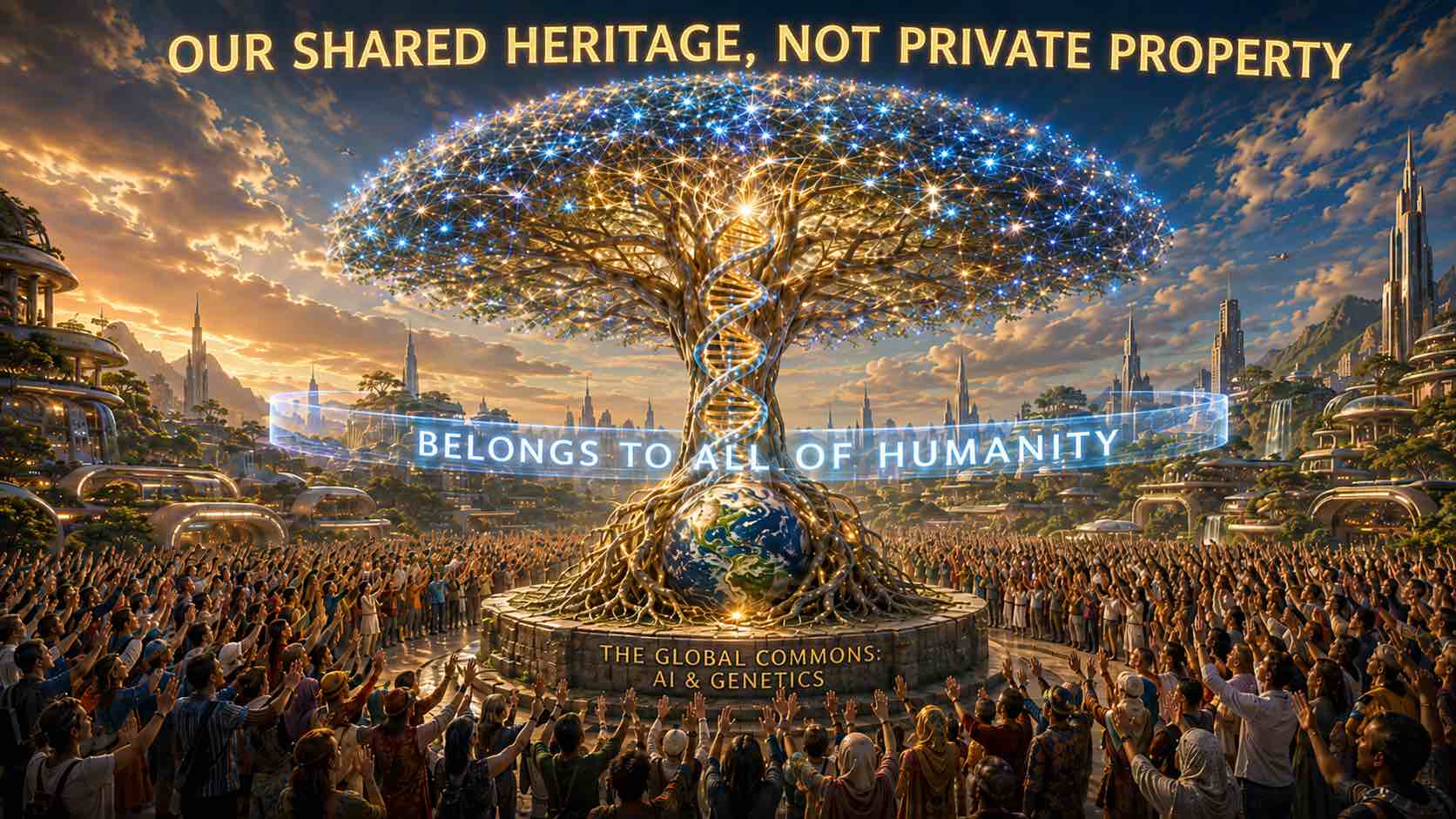
Like Water, It Belongs to Everyone.
At the dawn of civilization, every step humanity took was driven by the imperative of survival. Yet over the millennia, the true measure of progress was never the height of the stone walls we raised or the sophistication of our technological tools. The real test always remained the same: how we treated the weak — the destitute, the sick, and the elderly. When an ancient community shared its winter food stores with those too old to work and with children, when a medieval guild paid into a common fund to support its ailing masters, when a village built a poorhouse together — each of these gestures carried the same recognition that remains at stake today: the strength of a community is measured by what it does for those who cannot provide for themselves.
It was this profound sense of human responsibility that gave rise, a little over a century ago, to the safety nets and social achievements that placed human dignity at the center, in defiance of ruthless market forces. Between 1883 and 1889, Bismarck’s Germany introduced the world’s first comprehensive system of social insurance — health insurance, accident insurance, and eventually pensions — not out of benevolence, but because it recognized that the raw force of industrial capitalism would crush whatever conscious state intervention failed to protect. Barely half a century later, amid the wreckage of the Great Depression, Franklin D. Roosevelt’s New Deal and the Social Security Act of 1935 affirmed the same principle in the United States: the market alone cannot guarantee a humane outcome, and society must therefore act collectively to protect those it sweeps aside. In Britain, the 1942 Beveridge Report — which became the founding document of the modern welfare state — openly named five “giant evils”: want, disease, ignorance, squalor, and idleness, and declared that only planned, collective action could defeat them. These were not minor administrative reforms; they were civilizational turning points. Humanity made a conscious decision not to leave the fruits of technological and economic progress to the blind logic of the market alone.
Understanding and defending these historical achievements is not mere nostalgia — it is the key to the central message of this essay: in the midst of today’s radical technological transformation, we must extend these same principles if we are to safeguard our future. And yet, in the Western world today, every human being is treated as a mere “cost” to society before they are even born, even as we desperately try to sustain the unsustainable illusion of infinite economic growth within a finite environment. There is a bitter irony here: a nineteenth-century factory owner was at least forced to face his own workers — he saw their faces, knew their names, and took on real risk if he treated them too inhumanely, since they could go on strike. Today’s algorithmic capital has dissolved even that minimal human connection. The actors of the platform economy never encounter the people whose data they monetize.
The Mechanics of Modern Feudalism
Look beneath the surface, and the paradox strangling our era becomes immediately visible. Of the raw substance of our lives, only a single unit goes toward what we might truly call living, self-expression, and freedom; the remaining seven units are consumed entirely by producing, sustaining, and servicing that one fragment — paying the bills of daily existence. Consider this: the average urban renter spends as much as half their income on housing, while real-estate investment funds and algorithmically optimized rent-setting software — some of which have been investigated in several major U.S. cities on suspicion of price-fixing — deliberately push rents upward. A parent trying to work while raising a child often spends a substantial share of their income on childcare, within a system that has never properly accounted for the true social value of that labor.
In an age when technology could multiply human freedom without limit, the mechanized future instead risks becoming an engine of modern feudalism with no escape route. Power is concentrating to an alarming degree: critical infrastructure, computational capacity, and vast troves of data are accumulating in ever fewer hands, while this concentration often remains invisible, hidden behind the façade of democratic institutions and the illusion of a diverse, competitive market. Consider how a handful of cloud providers — on whose infrastructure virtually the entire digital economy runs — control the computing power without which no artificial intelligence model can be trained today; how the world’s cutting-edge semiconductor manufacturing is concentrated in the hands of a few fabrication plants; how a small number of large language models and search engines have become the narrow gateway through which humanity accesses its own collective knowledge. This is not fundamentally different from how the American “robber barons” of the late nineteenth century — the lords of oil, rail, and steel — brought entire arteries of the economy under their control, until the Sherman Antitrust Act and the progressive reforms of the turn of the century forced their breakup. The difference is that while the railroad monopoly ran on physical rails, today’s technological monopoly runs through human attention, through data, and through the very infrastructure of thought itself — which makes it far harder to recognize, and far harder to resist.
A capitalist class whose intellectual horizon is bounded by profit-seeking and ruthless cost minimization is building, through the blind acceleration of Moore’s Law and the endless scaling of data, a form of total monopoly that is dragging us inexorably toward an irreversible event horizon. At that point, classical market competition ceases to exist altogether, and broad segments of society become systemically redundant. During the Industrial Revolution, mechanized looms displaced hand-weavers en masse — the Luddite uprising was precisely a desperate, if misguided, response to that painful realization. But at least then, new jobs and new industries opened up for the displaced workforce. The question that confronts us today with unprecedented sharpness is this: what happens when technology does not merely displace a narrow trade, but begins to absorb the entire spectrum of cognitive labor and creative work — legal research, software development, graphic design, customer service, even medical diagnosis?
Whose Raw Material Is It?
For capital, money has long ceased to be merely a medium of exchange; it has become a code of power over the planet’s physical and intellectual resources. But how much longer can we keep hurtling toward a wall we ourselves have built out of our own greed? The recognition is urgent and unavoidable: we cannot accept that artificial intelligence and genetic technology — the essential building blocks of our future — should belong solely to the private property of a narrow elite. Every raw material, every vast dataset that feeds these systems, is not the achievement of those who have appropriated it; it was either given by nature or accumulated by the shared memory of thousands of years of human culture. Consider what a large language model is actually built from: millions of books, scientific papers, forum discussions, debates, and Wikipedia edits — the freely shared knowledge and creative labor of generations of human beings, subsequently locked away by a handful of companies behind patents and trade secrets, then rented back to society at a price. The same holds true in genetic technology: the mapping of the human genome and the evolutionary inheritance of millions of years of biodiversity belong to no single laboratory, and yet it has become increasingly common for private companies to patent genes, cell lines, and biological processes. What they did not create, they have no right to claim as their own.
The Necessary Extension: A New Social Contract
The time has come to radically redefine our collective future. Just as, a century ago, the movement for social justice won mandatory pensions and social insurance — consider how unimaginable it would have seemed to a Prussian factory worker in 1880 that he would one day be entitled to a state pension, or to an American thrown into unemployment by economic collapse in 1935 that he could receive state unemployment benefits — so too must we now, without delay, elevate both artificial intelligence and the tools of biological advancement into the category of extended social achievements. In practice, this could mean an unconditional basic income, financed in part through taxes on the data-mining and computational capacity of major technology platforms; it could mean publicly owned, open-source artificial intelligence infrastructure that grants access to the era’s most important means of production not to a handful of companies, but to society as a whole; and it could mean genetic-technology regulation that prevents the fundamental building blocks of life from being locked behind patent walls.
If this recognition requires us to disturb the previously sacrosanct, absolutized boundaries of private property, then that right must yield. No economic dogma can override the fundamental rights of human existence and the survival of civilization itself. Just as the progressive movements of the early twentieth century did not shrink from questioning the sanctity of unlimited freedom of contract and unlimited property rights when confronted with the realities of child labor, the absence of an eight- or ten-hour workday, and the total lack of workplace safety, so too must we now confront the fact that the current, unchecked concentration of technological ownership is incompatible with a humane future.
The Judgment of History
We cannot afford to wait any longer. Every moment of inaction is another brick in the wall of our own prison. History will show no mercy to those who stood by passively while a narrow circle appropriated humanity’s shared future — just as we today look back without leniency on eras when slavery, child labor, or the total absence of pensions and health insurance were accepted as the norm. Posterity will judge us with the same severity if we allow the fruits of artificial intelligence and biotechnology to concentrate in a few hands, knowing full well that another path was possible.
But this is not merely a moral question — it is also a question of systemic stability. Social systems, like natural processes, cannot indefinitely tolerate the accumulation of tension. The gap between exponentially concentrating economic power and a stagnant or shrinking base of broader social welfare cannot widen without limit before it is eventually resolved — just as stress does not quietly dissolve within the layers of the earth’s crust, but breaks to the surface as an earthquake once the pressure finds no timely release. History is full of such reckonings: revolutions, collapses, wars — all of which, in hindsight, always appear as though they could have been avoided, because the warning signs were there long before. If we fail to constrain the concentration of technological and economic power through deliberate, institutionalized measures — just as we did a century ago with social safety nets — then we will not avoid a sharp rupture through good fortune. We will fail to avoid it simply because accumulated tension eventually finds its own way out, and that path is rarely orderly or painless. The question, then, is not whether change is necessary, but whether we steer it ourselves, deliberately — or whether we allow the accumulated tension to force it upon us, in a far more chaotic and destructive form.
Now is the time to reclaim our future, to bring the fruits of technology into common ownership, and, after so many centuries, to build a just, human-scaled world in which progress serves not the exploitation of humanity by the machine, but finally, a dignified and free human life. Not because this is a beautiful ideal, but because the alternative — an uncontrolled eruption of accumulated tension — serves no one’s interest, neither those who stand at the top today, nor those beneath them.
Comments are closed