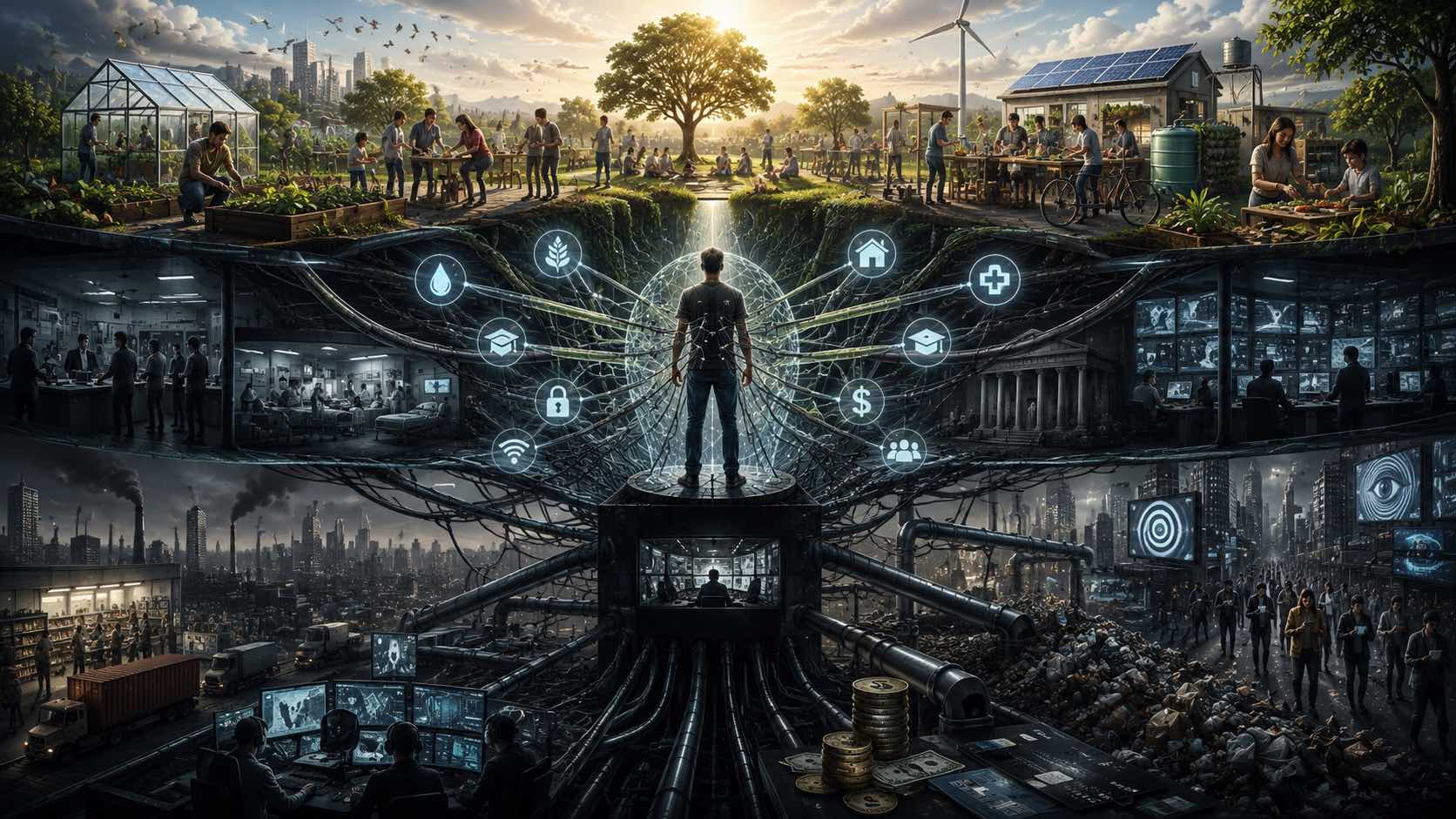
The Anatomy of Institutionalized Dependence
Following the systemic collapse of global institutions, the crisis did not stop at the level of macro-structures—slowly but surely, it trickled down to the most fundamental level: the individual. This movement was neither accidental nor the result of an isolated technical glitch. The vulnerability of modern man is not a flaw in the system, but its logical, even inevitable consequence: a carefully designed prerequisite for maintaining the status quo. Just as the statics of a building are not shaped by chance, the architecture of social dependence was not formed by the whims of history—it is a self-generating system, refined over decades, where every single element serves a single purpose: minimizing the autonomy of the individual.
The Illusion of Security and Artificial Insecurity
The fundamental mechanism of the current paradigm is deceptively simple, yet highly effective: it strips individuals and local communities of their autonomy, then forces them to rely exclusively on centralized networks for their most basic needs—water, food, housing, and healthcare. Where families and communities once produced their own food, built their own homes, and cared for their sick, today stands an invisible but omnipresent supply chain, whose operation few understand and even fewer control. Once these fundamental human rights were gradually commodified—water was bottled, food production was handed over to a few multinational corporations, and housing became an object of financial speculation—the masses were locked into a self-sustaining cycle of artificial insecurity.
This insecurity does not stem from poverty or a genuine lack of resources, but from a conscious construct that ties the mere right to exist to labor and obedience. The system demands continuous performance, adaptation, and loyalty in exchange for the individual simply having access to what, in principle, should belong to everyone. The result is a society paralyzed not by physical threats, but by existential fear—the constant feeling of uncertainty about whether we will still have a roof over our heads next month, whether healthcare will remain accessible, or whether we will keep our jobs. It is this fear that makes the masses passive, compliant, and ultimately controllable.
Information Asymmetry as a Weapon
This deeply ingrained dependence is primarily maintained and reproduced from generation to generation by information asymmetry. As long as the masses are kept in the dark and fail to understand how financial systems, technological infrastructures, and true historical narratives actually work, they remain easy to govern and control. This phenomenon has gained a new dimension today: American economist Shoshana Zuboff termed “surveillance capitalism” the process by which tech companies not only collect users’ behavioral data but sell it as a product—while the users themselves have no idea about the depth of the profiles being created about them or how these are used to influence their decisions.
Power suppresses deep understanding not by accident, but out of strategic consideration. Instead, it has built a standardized education system which—as education researcher Sir Ken Robinson explained in his widely cited lectures—copies the logic of factory production: it establishes a uniform curriculum, standardized tests, and uniform expectations that reward blind repetition and conformity over critical thinking and creativity. The goal is not to raise conscious, independently thinking architects of the future, but to continuously produce smoothly functioning, replaceable cogs for the economic machine. This system is not faulty because it is dysfunctional—on the contrary, it achieves its goal with terrifying efficiency: it produces adults who rarely question the framework in which they live.
The Collapse of Vertical Systems
However, a social model built on the oppression, fear, and material dependence of individuals is mathematically and logically unsustainable in the long run. This is not an ideological statement, but a necessity of systems theory: any structure that suppresses its inherent diversity and adaptability will sooner or later face the consequences of its own rigidity. As the complexity of the 21st century—climate change, technological acceleration, the interconnectedness of global financial systems—grows exponentially, top-down, vertical, hierarchical systems become increasingly incapable of processing information fast enough to adapt meaningfully. This phenomenon is clearly observable, for instance, in how traditional, slow-moving regulatory and governmental structures try to react, years late, to rapidly changing phenomena like the rise of artificial intelligence or the spread of disinformation on social media.
The system ultimately collapses under its own weight because—due to its self-preserving logic—it suppresses precisely the cognitive diversity, decentralized knowledge, and collaborative networks that would be essential for solving global crises. The more control tries to concentrate in one center, at a single peak of decision-making, the more vulnerable the entire system becomes to a single point of failure or abuse. Recognizing this structural vulnerability, however, is not just a diagnosis of the crisis, but also the spark of collective awakening: ever-broader segments of humanity are realizing that the institutions which promised security and care have actually become the wardens of their captivity—and this realization is what paves the way for a more conscious, decentralized, and human-centric order.
Reclaiming Autonomy: The Horizontal Alternative
This more decentralized arrangement, however, is no longer an abstract utopia, but a reality being built both technologically and socially. The only adequate, systemic response to the “artificial insecurity” created by vertical power is the development of open-source social operating systems and community-owned networks. When local, autonomous energy communities are formed, when independent, decentralized food supply chains are organized, and when knowledge sharing is finally freed from institutional monopolies, the individual takes back direct control over their own sustenance.
These horizontal, self-organizing networks sever the ties of dependence exactly where power has pulled them tightest: at basic needs. Network culture is not just a new economic model, but the rehabilitation of human dignity. In this new paradigm based on coordinate and collaborative relations, the individual is no longer an intimidated, replaceable cog in a closed, bureaucratic machine. Instead, they become a sovereign creator of a flexible, resilient, and free community—reclaiming that genuine autonomy which the centuries-old architecture of institutionalized dependence attempted to eradicate.
Comments are closed