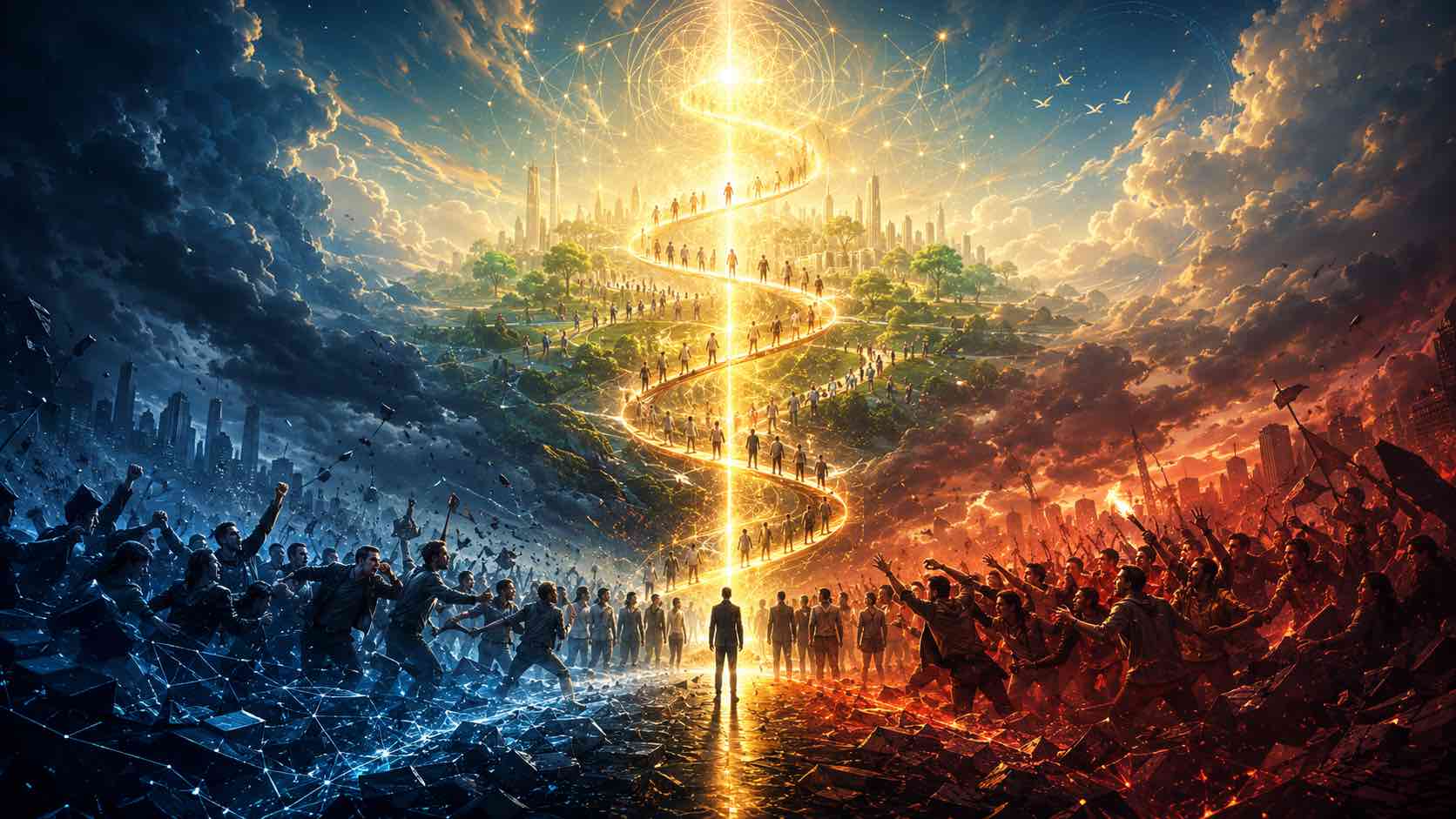
A Model of Social, Intellectual, and Conscious Development
Humanity has never possessed more information, technology, and productive capacity than it does today. We can communicate across continents in seconds, automate complex processes, map the human genome, observe distant galaxies, and coordinate millions of people through digital networks. Yet many of our most fundamental social problems remain unresolved.
Political polarization deepens. Economic inequality persists. Institutions lose legitimacy. Public debate increasingly becomes a contest of identities, emotions, slogans, and competing realities. Societies appear to move constantly, yet often without genuinely advancing.
This contradiction raises an important question:
What if much of what we call progress is merely horizontal movement within the same level of consciousness, organization, and social logic?
A society can change governments without changing its political culture. It can replace one ideology with another while preserving the same structures of domination. It can introduce new technologies while continuing to operate through fear, competition, scarcity, and exclusion.
The horizontal–vertical spiral offers a conceptual model for understanding this problem.
It distinguishes between three different forms of movement:
- horizontal movement between positions within the same system,
- vertical development toward greater complexity and responsibility,
- and spiral evolution, through which societies revisit recurring human problems at increasingly integrated levels.
The model does not claim that history follows a guaranteed path. Nor does it suggest that some people are inherently superior to others. Instead, it offers a framework for understanding why social transformation requires more than changing leaders, policies, or institutions. It requires a transformation in the level from which individuals and societies perceive, interpret, and organize reality.
The Horizontal Dimension: Movement Without Transformation
The horizontal dimension represents the field of competing positions, identities, interests, and ideologies.
In politics, this may appear as left versus right, liberal versus conservative, globalist versus nationalist, state control versus free markets, or centralization versus decentralization. In culture, it may appear as tradition versus innovation. In economics, it may appear as labor versus capital, regulation versus deregulation, or public ownership versus private ownership.
These differences are real. They can have significant consequences. Some policies are more humane, efficient, or sustainable than others. Horizontal distinctions should therefore not be dismissed as meaningless.
The problem begins when society assumes that movement between horizontal positions is equivalent to genuine development.
A political party may replace another party. A new elite may displace an old elite. A revolution may overturn one hierarchy only to construct another. The vocabulary changes, the symbols change, and the people at the top change, but the underlying logic remains familiar:
- power is concentrated,
- information is controlled,
- citizens are treated as passive followers,
- opponents are dehumanized,
- short-term interests dominate long-term responsibility,
- and institutions protect themselves rather than the public purpose they were created to serve.
In such cases, society moves across the surface of the system without changing its depth.
The horizontal political imagination usually makes a simple promise:
“If our side defeats the other side, society will improve.”
But the victory of one side does not automatically transform the level of thought shared by both sides. If both operate through fear, tribal loyalty, manipulation, and the pursuit of power, then the conflict remains inside the same developmental field.
The actors change places, but the stage remains the same.
This is why many historical transformations produce disappointment. People expect structural liberation but receive a new version of the old order. The pyramid remains intact; only the figure standing at its summit changes.
The Difference Between Power Hierarchies and Developmental Depth
The vertical dimension is easily misunderstood because verticality is often associated with domination.
Traditional hierarchies place rulers above subjects, managers above workers, experts above citizens, and institutions above communities. In such systems, being “higher” usually means possessing greater authority, wealth, status, or control.
This is the verticality of power.
The horizontal–vertical spiral proposes a different meaning: developmental verticality.
Developmental depth is not determined by social status. A wealthy or powerful person may operate from a narrow, fearful, and self-serving worldview. A person with little formal authority may demonstrate wisdom, empathy, responsibility, and systems awareness.
Vertical development refers to an increase in the capacity to:
- understand greater complexity,
- consider multiple perspectives,
- recognize interdependence,
- delay immediate gratification,
- accept responsibility for consequences,
- think across longer time horizons,
- integrate apparently opposing truths,
- and act beyond narrow self-interest.
A vertically developed perspective does not merely ask, “What benefits me?” or “How can my group win?”
It also asks:
- What are the consequences for others?
- What happens to the whole system?
- What will this decision produce in ten, fifty, or one hundred years?
- Which conditions are creating the conflict?
- How can legitimate needs on different sides be integrated?
- What structure would reduce the need for domination itself?
Developmental verticality therefore does not describe a hierarchy of human worth. All people possess equal human dignity. However, not every interpretation, decision, or level of responsibility is equally mature, informed, or capable of responding to complexity.
A child and an adult are equal in human value, but they do not possess the same developmental capacities. Similarly, a society organized around immediate survival cannot be expected to function in the same way as one whose members enjoy security, education, institutional trust, and meaningful participation.
Recognizing developmental differences does not justify oppression. On the contrary, it creates an obligation to build conditions that enable more people to develop greater autonomy, competence, and responsibility.
Why Development Takes the Form of a Spiral
Human development is not a straight line.
Individuals and societies repeatedly encounter the same fundamental questions:
- How do we survive?
- How do we create safety?
- Who belongs to the community?
- How should power be distributed?
- What does freedom mean?
- What responsibilities accompany freedom?
- How do we balance individuality and cooperation?
- How should we relate to nature, technology, and future generations?
These questions never disappear completely. They return in new historical, technological, and cultural forms.
For this reason, development is better represented as a spiral than as a ladder.
A ladder suggests that lower stages are simply abandoned. A spiral shows that earlier needs remain present but are reorganized within a wider structure.
An adult does not cease to require food, safety, belonging, or recognition. Rather, these needs become integrated into a more complex identity. Similarly, an advanced society does not eliminate competition, authority, tradition, markets, or individual ambition. It places them within broader systems of accountability, cooperation, and public purpose.
The spiral also explains why history often appears repetitive.
Societies revisit conflicts over authority, resources, identity, and freedom. Yet the context changes. A question once addressed at the level of tribe may later appear at the level of nation, global economy, digital network, or planetary civilization.
The same pattern returns, but not necessarily at the same level.
If development occurs, humanity revisits old problems with:
- broader knowledge,
- more inclusive identities,
- improved institutions,
- greater technological power,
- and deeper awareness of systemic consequences.
A circle returns to the same point. A straight line never returns. A spiral does both: it returns to familiar territory while moving through a new level of depth.
The Crisis of Horizontal Politics
Modern political systems are largely organized around horizontal competition.
Parties compete for voters. Interest groups compete for influence. Media platforms compete for attention. Nations compete for resources, investment, technological advantage, and geopolitical power.
Competition can produce innovation and accountability. Yet when competition becomes the dominant organizing principle, public life is reduced to permanent conflict.
Every issue becomes a battlefield. Every compromise appears as weakness. Every opponent becomes a threat. Complex problems are compressed into emotionally satisfying binaries.
In this environment, political communication no longer seeks understanding. It seeks mobilization.
Citizens are encouraged to identify with political camps rather than participate as independent, responsible members of society. Their role is not to think, evaluate, or co-create. Their role is to support, oppose, repeat, and react.
This creates a paradox. Democratic systems formally recognize citizens as the source of political legitimacy, while the practical operation of politics often treats them as objects of persuasion, data extraction, and behavioral management.
The horizontal spiral model suggests that the central political conflict is not merely between ideological camps. It is also between different levels of political consciousness.
At one level, politics is understood as domination:
Who controls whom?
At another level, it becomes representation:
Who speaks for whom?
At a more developed level, it becomes participation:
How can citizens shape the systems that affect them?
At a still more integrated level, politics becomes collective intelligence:
How can society organize its knowledge, values, resources, and responsibilities to serve the long-term well-being of the whole?
These levels can coexist within the same country, institution, or individual. A society may possess advanced technology while maintaining primitive political behavior. It may speak the language of democracy while operating through manipulation, secrecy, and elite competition.
True political development therefore cannot be measured only by elections, constitutions, or technological modernization. It must also be measured by the quality of participation, transparency, accountability, public reasoning, and shared responsibility.
Beyond Left and Right
The horizontal–vertical spiral does not claim that ideological differences should disappear. Rather, it suggests that many ideological conflicts contain partial truths that must be integrated at a higher level.
Conservative traditions often emphasize order, continuity, responsibility, local belonging, and the accumulated knowledge embedded in culture.
Progressive traditions often emphasize equality, reform, inclusion, social mobility, and the need to challenge unjust power.
Liberal traditions emphasize individual freedom, rights, pluralism, and protection from coercive authority.
Social and communitarian traditions emphasize solidarity, shared infrastructure, mutual responsibility, and protection from economic domination.
Each perspective identifies genuine human needs. The problem emerges when one principle is treated as complete and absolute.
Order without freedom becomes oppression.
Freedom without responsibility becomes fragmentation.
Equality without diversity becomes forced uniformity.
Competition without solidarity produces exclusion.
Solidarity without autonomy can produce dependency and control.
Tradition without renewal becomes stagnation.
Innovation without continuity becomes disorientation.
A vertically integrated politics does not mechanically compromise between these values. It seeks a structure in which they can operate together at a more complex level.
The question is no longer:
Which side must defeat the other?
The question becomes:
What deeper system could preserve the legitimate function of each value while reducing its destructive extremes?
This is not political neutrality. Nor is it an attempt to avoid moral judgment. Some actions and systems are clearly harmful. But effective transformation requires understanding the needs, fears, and developmental conditions that sustain them.
A higher-level solution does not simply silence conflict. It changes the environment that continually reproduces conflict.
Human Needs as the Foundation of Social Development
No society can sustainably demand higher consciousness from people whose basic conditions are unstable.
A person facing hunger, homelessness, violence, or constant economic insecurity will naturally focus on immediate survival. This is not a moral failure. It is a rational response to material conditions.
For this reason, vertical development must never become an excuse for blaming individuals for the consequences of structural deprivation.
Social consciousness is shaped by social conditions.
If a society wants citizens who are capable of long-term thinking, cooperation, creativity, and civic responsibility, it must provide a foundation that makes such capacities realistically possible.
This includes:
- secure access to food and housing,
- healthcare,
- meaningful education,
- personal safety,
- reliable public institutions,
- access to information,
- time beyond mere survival,
- and genuine opportunities for participation.
Material security alone does not guarantee wisdom. Affluent societies can remain selfish, fragmented, and politically immature. Yet chronic insecurity makes higher development far more difficult.
A mature social model must therefore connect inner development with institutional design.
Personal responsibility matters, but so do the systems that shape available choices.
Consciousness influences institutions, and institutions influence consciousness. The relationship is circular—and therefore spiral.
From Passive Populations to Collective Intelligence
One of the most important vertical transitions is the movement from passive membership to active participation.
Traditional systems often assume that a small group governs while the majority follows. Knowledge flows downward. Decisions are made at the top. Citizens are consulted occasionally, usually through elections or controlled public processes.
Digital technology creates the possibility of a different model.
Communities can now share knowledge, coordinate resources, verify information, deliberate across distance, and document institutional decisions. Public participation can become continuous rather than occasional.
But technology alone does not create collective intelligence.
A digital platform can support democratic cooperation, but it can also amplify manipulation, surveillance, tribalism, and misinformation. The level of technology does not determine the level of consciousness with which it is used.
Collective intelligence emerges only when participation is supported by:
- transparent information,
- verifiable evidence,
- clear decision procedures,
- protection against concentrated influence,
- educational access,
- accountability,
- and a culture capable of distinguishing disagreement from hostility.
The goal is not to make every person an expert in everything. It is to create systems in which different forms of knowledge can be combined without allowing expertise to become unaccountable authority.
Horizontal equality and vertical competence must be integrated.
Every person should have equal dignity and legitimate access to participation. At the same time, decisions should take relevant knowledge, experience, evidence, and responsibility seriously.
The challenge is to recognize competence without creating permanent castes of power.
The Danger of Declaring Oneself “More Developed”
Any theory of vertical development contains a serious risk.
Individuals, movements, institutions, or elites may declare themselves more conscious, evolved, intelligent, or spiritually advanced than others. From this claim, they may conclude that they have the right to rule without consent.
This would transform developmental verticality back into a hierarchy of domination.
A credible model of development must therefore include safeguards against self-declared superiority.
Higher development should not be measured by status, wealth, academic titles, ideological loyalty, spiritual language, or institutional position.
It should be evaluated through observable capacities and consequences:
- Can the person or system understand opposing viewpoints accurately?
- Can it revise its beliefs when evidence changes?
- Does it accept accountability?
- Does it distribute or concentrate power?
- Does it increase the agency of others?
- Does it reduce unnecessary suffering?
- Can it think beyond immediate self-interest?
- Does it protect future generations?
- Can it integrate complexity without hiding behind vague language?
- Does it create conditions for others to develop?
A truly developed system does not merely claim wisdom. It demonstrates humility, transparency, and self-correction.
The greater the claimed level of consciousness, the greater the required level of accountability.
Horizontal Equality, Vertical Responsibility
The future cannot be built through purely horizontal organization or purely vertical organization.
A completely horizontal system may refuse to recognize differences in knowledge, competence, responsibility, or experience. It may assume that every opinion has equal validity regardless of evidence or consequence.
A purely vertical system may become rigid, authoritarian, and detached from the people it claims to serve.
A mature social architecture must integrate both dimensions.
Horizontally, all people possess equal dignity, fundamental rights, and legitimate standing within society.
Vertically, responsibilities differ according to knowledge, capacity, consequence, and role.
A surgeon and a patient are equal as human beings, but they are not interchangeable during an operation. A public official is not more valuable than a citizen, but the official carries greater responsibility because their decisions affect more people.
The higher the position of influence, the stronger the requirements for transparency, competence, ethical conduct, and public accountability should become.
In many existing systems, the opposite occurs. Those with the least power are subject to the greatest supervision, while those with the greatest power enjoy the broadest secrecy and freedom from consequences.
A vertically mature society would reverse this logic.
Responsibility would increase with power.
Transparency would increase with influence.
Accountability would increase with the scale of potential harm.
Development as Integration, Not Erasure
Every developmental stage emerges because it solves a real problem.
Strong authority may arise to create order in chaotic conditions. Individualism may arise to liberate people from rigid collective control. Markets may arise to coordinate production and exchange. Welfare institutions may arise to protect people from the destructive effects of unrestrained markets. Decentralized networks may arise to reduce dependence on centralized authorities.
Each system contains a function. Each also creates new problems.
Development does not require destroying everything that came before. It requires understanding which functions must be preserved and which forms must be transformed.
The mature question is not:
How do we eliminate the old system completely?
It is:
Which human need did the old system address, and how can that need be served through a less destructive and more conscious structure?
This is the logic of spiral integration.
The goal is not to return to the past, nor to worship the new simply because it is new. The goal is to preserve useful functions while transcending outdated limitations.
A Civilization Capable of Seeing Itself
The deepest promise of the horizontal–vertical spiral is the emergence of a civilization capable of observing its own patterns.
Most systems reproduce themselves unconsciously. Institutions protect routines long after their original purpose has disappeared. Political conflicts repeat because the participants react to one another without examining the structure generating their reactions.
A more conscious civilization would become capable of asking:
- Why do our systems repeatedly produce inequality?
- Why does power concentrate even after democratic reforms?
- Why does technological progress often increase both freedom and control?
- Why do institutions prioritize survival over purpose?
- Why do societies continue to reward short-term extraction over long-term regeneration?
- Why do citizens become more connected technologically while becoming more divided socially?
To see these patterns is already a form of vertical movement.
The next step is to redesign the structures that reproduce them.
A civilization capable of seeing itself would treat institutions as tools rather than sacred objects. It would evaluate them according to whether they continue to serve human and ecological well-being.
It would not confuse economic growth with development, information with knowledge, connectivity with community, or power with competence.
It would understand that no technology can compensate for a collapse of trust, meaning, responsibility, or social cohesion.
The Spiral as a Practical Framework
The horizontal–vertical spiral can be used as a practical method for evaluating social proposals.
When confronted with a conflict, institution, or reform, we can ask four questions.
1. What is the horizontal conflict?
Which sides, identities, interests, or ideological positions are competing?
2. What deeper needs are represented?
What legitimate human needs are hidden beneath the visible conflict—security, freedom, dignity, belonging, recognition, stability, participation, or justice?
3. What level of consciousness and organization is producing the conflict?
Is the system operating through fear, domination, competition, representation, cooperation, or integration?
4. What higher-level structure could preserve legitimate needs while reducing destructive patterns?
This final question is the beginning of vertical transformation.
The aim is not to find a vague middle ground. It is to design a more intelligent system.
Conclusion: Moving Beyond the Battle for Position
Humanity is extraordinarily skilled at moving horizontally.
We change leaders, institutions, technologies, borders, laws, and ideologies. Yet we often carry the same fears, power structures, and patterns of exclusion into the new systems we create.
The horizontal–vertical spiral reminds us that genuine transformation requires more than movement. It requires a change in depth.
Horizontal change asks:
Who will control the existing system?
Vertical development asks:
From what level of awareness, complexity, and responsibility is the system being organized?
Spiral evolution asks:
How can we integrate the lessons of earlier stages into a more inclusive and conscious form?
The purpose is not to climb above other people. It is not to create a new intellectual, political, or spiritual elite.
The purpose is to build individuals, institutions, and societies capable of seeing wider relationships, carrying greater responsibility, learning from error, and creating conditions in which others can develop as well.
The real transition is not from one side of the horizontal battlefield to the other.
It is from unconscious opposition to conscious participation.
From domination to responsibility.
From fragmentation to integration.
From a society that repeatedly changes the figures at the top of the pyramid to a civilization capable of transforming the logic of the pyramid itself.
The spiral begins when we stop asking only how to defeat the other side and begin asking what level of understanding could make the conflict itself transform.
Comments are closed