The Society of False Desires and the Path Back
Introduction: A Converging Crisis
The distortions of visual culture, the manipulation of neuroplasticity, and the shortcomings of the education system are not isolated phenomena — together they produce a deeper, personal-level disorientation. This text examines the process by which a confused, destabilized person — because of their own conditioning — begins to impose on themselves a behavioral pattern that seems safe but in fact carries real losses. We can call this phenomenon disneyfication or hollywoodization: the process by which a person raised on visual culture, lacking critical reflection, tries to force onto their own life the desires presented on screen.
It’s worth stating upfront: this is an interpretive framework, not a scientifically proven causal chain. Related ideas can be found in the cultural-critique tradition as well — Guy Debord’s The Society of the Spectacle, Jean Baudrillard’s theory of the simulacrum, or Neil Postman’s Amusing Ourselves to Death all examine how the media-mediated image comes to replace direct experience. The argument that follows belongs to this tradition, with its own conceptual apparatus — and this is exactly the apparatus the following chapters build up piece by piece: first the root of the phenomenon (the lack of self-confidence), then its mechanism (hollywoodization), and finally the decision point where the individual can choose between maintaining the pattern and breaking out of it.
The Roots of Low Self-Confidence
The starting point of the phenomenon is a lack of self-confidence. One possible explanation is that the demand for inner steadiness — and the upbringing that would cultivate it — has gradually eroded out of the education system, out of society, and above all out of the family. Where character, self-knowledge, and patience used to be built up slowly, across generations, through direct role-modeling, today consumer culture’s array of products and the false desire-clusters they offer fill that void instead. This doesn’t mean consumption is inherently harmful — rather, it means that when the source of desire comes exclusively from outside, from industrially produced images, the construction of identity also starts happening from the outside in, rather than from the inside out.
This is the point where the void waits to be filled — and this is exactly where the image steps in: if inner steadiness hasn’t developed strongly enough for a person to draw self-confidence from their own resources, visual culture readily offers ready-made, instantly consumable patterns instead. The next chapter shows the concrete tools through which this “filling in” happens.
The Mechanism of Hollywoodization
To keep the consumer society functional, providers must continuously bring new desires to life. To do this, they use a well-documented psychological toolkit whose purpose is to get the message past the viewer’s conscious critical filter. The underlying structure is always the same: a legitimate, deep human desire is linked to a consumer action that has no real logical connection to it — so the fulfillment of the desire becomes an illusion, while the consumption itself remains very real.
Historical example: Edward Bernays’s 1920s campaign became a textbook case in the history of PR for good reason: he positioned smoking for women not as a simple product but as a symbol of freedom (the “torches of freedom”), linking a legitimate cause in itself — gender equality — to a health-damaging product. The trick lies in binding a deep, legitimate desire (autonomy) to a consumer act with no factual relation to it.
Pop-culture example: The recruitment surge often mentioned anecdotally after the release of G.I. Jane (1997) is a recurring story about the entanglement of popular culture and real social behavior — though the precise causal link and the true scale of the effect are disputed based on actual military recruitment data, the case illustrates the underlying principle well: a powerful visual narrative can trigger measurable behavioral change, even if the mechanism behind it is more complex than attributing it to a single film.
Both examples carry the same lesson: the image doesn’t merely inform — it gives direction to desire, and that directed desire is what later resurfaces, again and again, in our everyday decisions — most sharply in the moment we must choose between the easier and the harder path.
The Dilemma of the Easy Path and the Hard Path
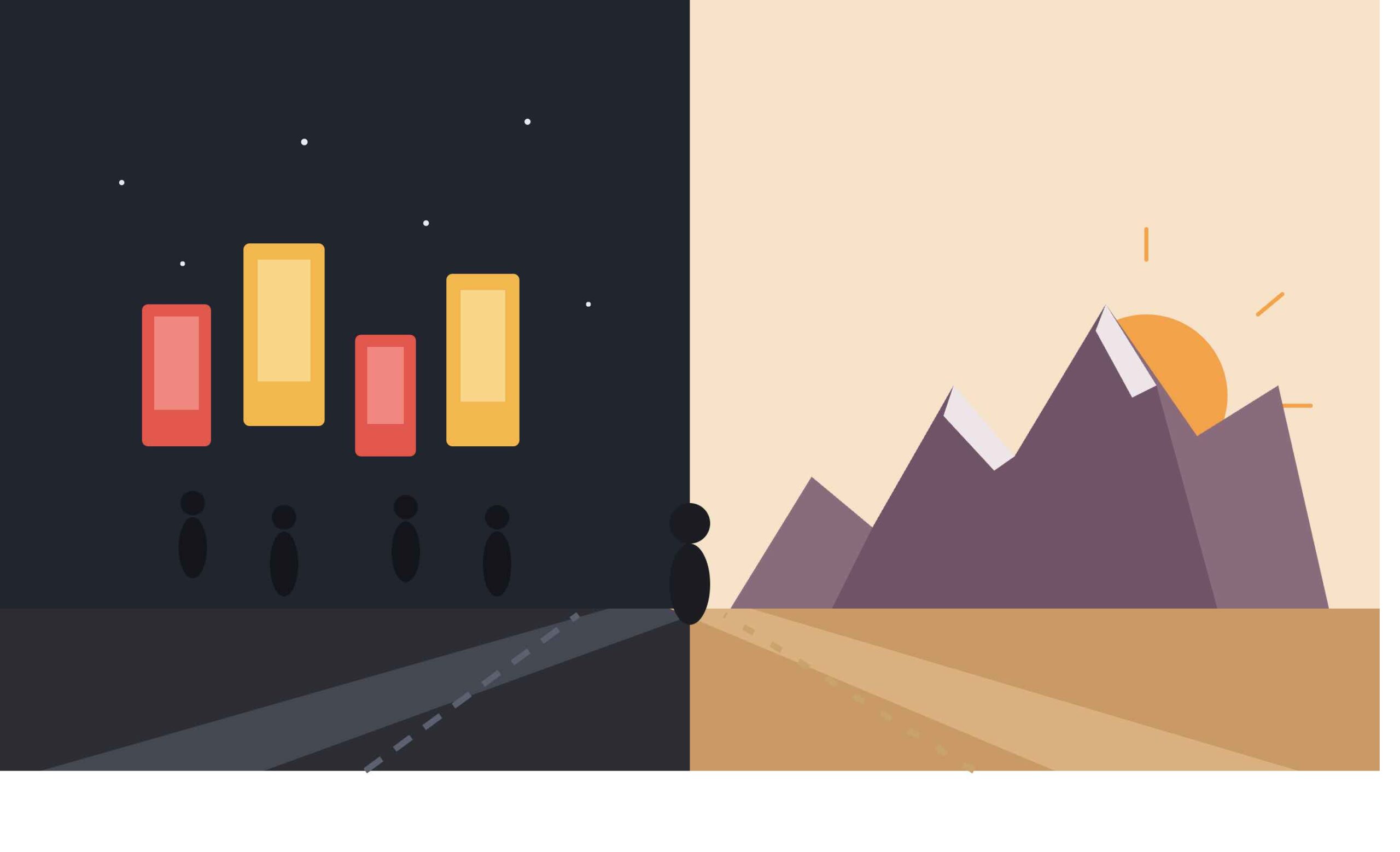
This decision point is nothing new — humanity has long been familiar with the choice between the well-trodden, seemingly safe path and the unknown, uncertain path that actually leads to real growth. It’s worth unpacking exactly what these two paths mean in practice, because the most important difference between them isn’t comfort versus discomfort — it’s whether each path produces a genuine, inwardly-grounded identity, or merely its appearance.
The easy path means the person adopts ready-made, socially approved patterns: fashionable desires, tried-and-tested roles, the life-script the crowd is already following. Its appeal lies in offering instant validation — there’s no need to take an individual risk, no need to search for one’s own answers; it’s enough to accept, collectively, whatever “everyone” is doing. But this kind of security comes at a price: the person gives up the chance to discover what they actually want, and instead replays a script handed to them from outside, over and over again.
The hard path, by contrast, requires the person to face their own uncertainty and failures, and to accept the uncomfortable fact that answers cannot be received ready-made — they have to be earned. This path is slower, less spectacular, and offers no instant, mass validation. In return, though, it produces genuine self-knowledge and self-confidence built from real, lived experience — the kind that doesn’t collapse the moment the external model changes or becomes unavailable.
Consumer society is structurally built to steer our decisions toward the easy path — not only in shopping, but in our relationships and in how we run our lives. When an entire society chooses the same easy path, sheer mass presence starts to function as its own justification: “if this many people are doing it, it must be the right choice.” But this kind of collective validation is deceptive: mass acceptance is not the same as correctness — it only shows that many people chose the same comfortable escape from uncertainty. Meanwhile, the very concepts of “one’s own life path” and “life purpose” are increasingly squeezed out of everyday language — not because they’ve lost their importance, but because there’s no longer a linguistic or cultural framework in which to express them. When we have no word for something, it becomes harder to even think about it — and this creates an extra obstacle specifically for those who choose the hard path: they must contend not only with their own uncertainty, but with a surrounding language and culture that offers no support for their search.
This dilemma isn’t a one-time decision but a constantly recurring choice-point — in every relationship, at every turning point in life, the question resurfaces: do I repeat the familiar pattern, or do I accept uncertainty in order to build something more genuine? The next chapter shows what happens when this question is answered, persistently, in favor of the easy path — especially within relationships.
False Desires, False Relationships
One of the hardest consequences to notice plays out in relational dynamics. When two people meet, and both of their desires have largely been shaped by external, mediated images, the encounter doesn’t actually happen between the two people — it happens between their two imagined desires. This pattern persists precisely because self-regulation, self-observation, and self-discipline are not comfortable skills to have — building them takes time, failure, and conscious practice, and on top of that, knowledge of our own neuroplastic functioning isn’t part of general education either. Without this knowledge, a person easily mistakes the mediated pattern for their own genuine desire — and it’s exactly this confusion that the next section illustrates with a concrete, easily recognizable image.
Role-Play Instead of Reality: The Rambo–Sarah Contrast
This pattern can be well illustrated through a sharp contrast. Many men try to model themselves after John Rambo — the lone, tough, emotionally guarded hero — and set out, in that role, to find their own Sarah, the idealized, faithful woman figure from Steel Magnolias. But the real, living Sarah isn’t looking for a movie archetype — she’s looking for someone emotionally present and accessible. The two imagined roles — the mediated male ideal and the mediated female ideal — don’t actually fit together, because neither is based on a real person, but on a constructed image of desire. The drama lies precisely in the fact that both people sincerely believe they are seeking each other — while in reality, each is chasing a shadow projected from a movie screen.
This pattern is inherited across generations: meanwhile, the children of these parents want to be Doctor Dooms or other Marvel heroes — not because these characters embody real, transferable human qualities, but because the parents themselves are unable to offer an authentic, reality-grounded model the child could identify with instead. The adult carrying a false pattern passes on a false pattern — and the child learns what it means to be human within that same mediated space. This is how the circle closes: the unresolved desires of one generation become the starting point of the next, unless someone consciously breaks the chain.
This realization — that the pattern can be inherited, but can also be interrupted — leads into the text’s final, practical question: what can an individual actually do if they want to step out of this cycle?
The Way Out: Self-Knowledge and Self-Regulation
Recognizing the above — that an externally, industrially manufactured system of desire is steering our decisions — is in itself a difficult and uncomfortable process, because it means confronting the fact that many of our past decisions were driven by a borrowed desire rather than our own. And yet, this very recognition is what can hand control back to the individual — it is the practical starting point of the hard path. This requires developing three interlocking skills:
- Self-regulation: the ability to distinguish between momentary, externally triggered impulses and long-term goals we’ve genuinely chosen for ourselves.
- Self-observation: becoming aware of whether a given desire, decision, or reaction is truly our own, or whether we’re repeating a mediated pattern we’ve seen before.
- Self-discipline: sticking with the harder, more genuine path even when the easier path appears to carry greater social approval.
Together, these three skills form the inner infrastructure without which choosing the “hard path” remains nothing more than good intention, with no practical follow-through. Conversely, if someone consciously practices them, previously automatic, adopted patterns gradually become recognizable — and, eventually, can be dismantled.
A Note on the Limits of This Framework
It’s worth emphasizing that this analysis offers a single, sweeping explanatory framework for an extremely complex phenomenon. Psychological research today tends to think in terms of multi-factor models instead — genetic predisposition, early attachment patterns, socioeconomic circumstances, and peer-group influence all play a role in how a person’s self-esteem and relational patterns develop. The media-critical perspective this essay belongs to adds an important and legitimate angle to the picture, but on its own it rarely provides a complete explanation for any single person’s life story. Perhaps the most productive way to read this piece is not as a closed truth, but as a useful lens — one that makes something visible worth thinking further about, alongside personal experience, other perspectives, and, where needed, professional support.
Comments are closed